Cytochrome P450 Family 3 Subfamily A Member 4 or CYP3A4 gene belongs to the cluster of cytochrome P450 genes and is located on chromosome 7.
The family of Cytochrome P450 gene gives instructions for the production of enzymes that are responsible for the metabolism (the process by which drugs are broken down or chemically altered by the body to bring about the effect) of drugs, hormones, and other xenobiotics (substances not produced by the body).
The CYP3A4 gene produces the CYP3A4 enzyme that belongs to a group of monooxygenases (enzymes that contain one oxygen atom). It is involved in the metabolism of nearly 50% to 60% of the currently prescribed drugs, including acetaminophen, codeine, cyclosporin A, diazepam, etc.
The CYP3A4 gene is also involved in the production of cholesterol, steroids, and other lipids (fats).
Along with the CYP3A5 gene, the CYP3A4 gene is found predominantly in the liver.
There are over 20 variants (types) of the CYP3A4 gene that have been studied. Based on the presence of the CYP3A4 variant people carry, they can be classified as:
The *22, *1, *29, *15, etc., mentioned above are star alleles. Star alleles are used to name different haplotypes. A haplotype is a group of gene changes that are inherited together (CYP3A4*20, CYP3A4*1).
Inducers speed up the activity of the CYP3A4 enzyme, leading to quicker metabolism of the substances that the enzyme acts on.
Some drugs that increase or induce CYP3A4 activity are:
Apart from drugs, some insecticides and pesticides are also known to induce CYP3A4 genes. These include
Inhibitors slow down the activity of the CYP3A4 enzyme, resulting in the slower metabolism of substances that the enzyme acts on.
Some drugs inhibit or reduce CYP3A4 activity, and these include:
CYP3A4 gene inhibitor drugs can be classified based on their potency as – strong, moderate, or weak inhibitors.
CYP3A4 has fewer variants (types) than other CYP genes, and only a few of them are known to affect enzyme function. There are around 20 variants of this gene that have no clinical significance. Few significant variants include CYP3A4 *22, *1B, and *18B.
Also referred to as rs35599367, people with the T allele of this haplotype show decreased CYP3A4 enzyme activity. This haplotype is found in 4% to 8% of the population.
Studies show that people with T/T allele had two times lower enzyme activity than those with the C allele. This is important because people having the T/T genotype require a 40% lower dose of simvastatin (a cholesterol-lowering drug).
Children with the CYP3A4*22 variant show improved asthma control by taking fluticasone propionate (a drug used to treat asthma).
Research also states that CYP3A4*22 carriers were less likely to suffer from severe hot flashes on taking tamoxifen therapy (used for breast cancer).
rs2740574 is a single nucleotide polymorphism or SNP in the CYP3A4 gene. The presence of the G allele in this SNP in this gene is known as CYP3A4*1B.
The *1B haplotype may be associated with methadone overdose and fatal intoxication.
The G allele of this haplotype also increases the risk for prostate, ovarian, and lung cancers.
Also denoted as rs2242480, this variant of the CYP3A4 gene affects fentanyl (an opioid pain medication) dosage. Research states that patients with *18B/*18B alleles required lesser fentanyl dosage to control pain than patients with *1/*1 genotype.
Some interactions of the CYP3A4 gene with herbal medicines and food can reduce its metabolic effect.
Therefore, most doctors take a thorough history of all medications, herbal supplements, or alternative medicines that you may be taking to avoid any adverse reactions and prevent reduced CYP3A4 metabolism.
Genetic testing may be advised before prescribing drugs that are metabolized by the CYP3A4 gene. This is particularly true while prescribing simvastatin, fluticasone propionate (in children), tamoxifen, methadone, and fentanyl.
Acetaminophen is a common drug prescribed for pain and fever. It is both an analgesic (pain relievers) and antipyretic (used to treat fevers).
Acetaminophen is sold under the brand names Paracetamol, Tylenol, and Panadol.
Acetaminophen is used to treat fever, flu, common cold, headaches, body aches, toothaches, menstrual pain, and even arthritis pain. It is available without the need for a prescription in most parts of the world.
As of 2018, acetaminophen was the 20th most prescribed drug in the United States.
Acetaminophen works by changing the way the body experiences pain and increased temperature.
This drug works by blocking the release of certain chemicals that signal pain sensations to the brain. As a result, the person does not feel the intensity of pain.
Acetaminophen also communicates to the heat-regulating center of the brain and asks it to lower the body’s temperature. This helps bring down the fever.
This drug is usually available as oral pills. In some cases, it may also be administered intravenously.
Most people can tolerate acetaminophen well. However, some may develop some allergic reactions.
Some studies report that the use of acetaminophen during pregnancy increases the risk of childhood asthma in babies.
Acetaminophen overdose can lead to severe liver damage. Here are some of the symptoms of Acetaminophen overdose:
Acetaminophen can interact with many other drugs and can cause increased side effects or nullify the effects of the drugs. Make sure you notify your doctor if you use the below medications.
The TRPV1 gene contains instructions for the production of a protein called transient receptor potential cation channel subfamily V member 1. This protein helps the body sense pain.
It is activated in response to high temperature, acidic conditions, and upon consumption of certain foods like hot peppers or mustard.
Acetaminophen is converted into an intermediary metabolite called N-arachidonoylphenolamine (AM404) by the fatty acid hydrolase.
Studies show that this metabolite activates the TRPV1 protein, contributing to the pain-relieving effects of this drug.
Glucuronidation is an essential detoxification pathway for acetaminophen clearance from the body.
The UGT1A gene (UDP glucuronosyltransferase 1 family, polypeptide A cluster gene) helps produce the UGT1A enzyme that helps in acetaminophen glucuronidation.
rs8330 is a Single Nucleotide Polymorphism or SNP in the UGT1A gene.
The G allele of this SNP is associated with increased acetaminophen glucuronidation and a lower risk of acetaminophen overdose.
| Genotype | Implications |
| GG | Very high acetaminophen glucuronidation activity and very low risk of acetaminophen overdose |
| CG | Moderately high acetaminophen glucuronidation activity and lesser risk of acetaminophen overdose |
| CC | Normal acetaminophen glucuronidation activity and a normal risk of acetaminophen overdose |
The OPRM1 gene (opioid receptor mu 1 gene) helps produce the mu (μ) opioid receptor protein. This protein is a part of the opioid system in the body that regulates pain.
rs1977791 is an SNP in the OPRM1 gene. People with the G allele of this SNP require a higher dose of medication for pain relief compared to the A allele carriers.
About 19% of the global population has this minor G allele.
| Allele | Implications |
| G | Require higher doses of acetaminophen for pain relief |
| A | Require normal doses of acetaminophen for pain relief |
According to the Food and Drug Administration (FDA), adults should not consume more than 4g of acetaminophen in a day or 325 mg/dose. For children younger than 12, the recommended dosage limit per day is 75mg/kg of body weight.
If you are consuming acetaminophen for the first time, carefully watch out for allergy symptoms like shortness of breath, itching, hives, and swelling.
Acetaminophen is usually safe for pregnant and breastfeeding women. However, it is always safer to inform your doctor about your pregnancy.
Acetaminophen overdose can cause dangerous side effects in people with existing liver problems. Talk to your doctor before consuming the drug.
It may not be safe to use acetaminophen in combination with allergy, cold, and cough medications in children younger than two. Do not combine medications unless instructed by the pediatrician.
Genetic testing will help understand an individual’s response to acetaminophen and give insights on how quickly the drug is cleared from the body and dosages that may lead to toxicity.
Genetic testing can make dosage planning more precise and customized to a person’s genetic changes.
Acamprosate is a drug used to treat alcoholism or Alcohol Use Disorder (AUD). AUD is one of the leading causes of morbidity and premature mortality worldwide.
AUD is characterized by problems with controlling one’s alcohol intake, being excessively occupied with alcohol, and having withdrawal symptoms when alcohol consumption is reduced or stopped.
This disorder can cause a significant impact on your daily activities.
Acamprosate is the first drug that was developed specifically to maintain alcohol abstinence in alcoholics. It is available as Acamprosate Calcium (Campral).
Most other medications used to treat Alcohol Use Disorder (AUD) work by reducing the pleasurable effects of alcohol on the brain or giving rise to side effects that act as a deterrent for alcohol use.
Acamprosate is one of the three medications approved by the FDA for treating alcoholism. It works by reducing the brain’s dependence on alcohol by interacting with the neurotransmitter systems.
Apart from managing alcoholism, Acamprosate is also used to reduce symptoms like insomnia, anxiety, and restlessness.
Unlike other medications used to treat alcoholism, Acamprosate is non-habit forming and will not lead to prescription drug abuse.
In patients with alcoholism, there is an imbalance between the neuronal excitation and inhibition regulated by glutamine in the brain.
Excitation and inhibition are the two forces that are responsible for the function of the nervous system.
This results in alcohol withdrawal symptoms like headaches, nausea, tremors, anxiety, hallucinations, and seizures.
Acamprosate interacts with glutamate and GABA neurotransmitters in the Central Nervous System (CNS) to restore the balance between excitation and inhibition.
It binds to the GABA B receptors and indirectly affects the GABA A receptors to restore the balance.
Acamprosate is a safe drug. It may cause mild side effects, which subside as the treatment progresses. Since this drug is not metabolized in the liver, it has no liver-related side effects, as seen in most drugs.
Some common side effects of Acamprosate are:
Other severe side effects of Acamprosate that require urgent medical attention include:
Though a majority of drugs undergo metabolism in the liver, Acamprosate does not. Therefore, it is less likely to cause any drug-drug interactions via the cytochrome P450 inhibition mechanism.
Drug metabolism is the process of modifying drugs in the body so that they can be eliminated more easily. Most of the drug metabolism occurs in the liver, as the enzymes that facilitate the reactions are concentrated there.
Cytochrome P450 is a family of enzymes that are responsible for detoxifying chemical substances from the body. These enzymes can be induced or inhibited by different drugs called cytochrome P450 inducers and inhibitors, respectively. Thus, any alteration in this system results in drug-drug interactions.
When acamprosate is taken with other drugs used to treat alcoholism like diazepam, disulfiram, or antidepressants, it does not cause adverse effects.
A clinical trial showed that co-administering naltrexone with Acamprosate increased the rate and extent of acamprosate absorption. Thus, this combination of drugs is an excellent way to increase the bioavailability of Acamprosate without changing its tolerability.
The GRIN2B or Glutamate Ionotropic Receptor NMDA gene provides instructions for the production of GluN2B protein. This protein is found in the nerve cells in the brain, mainly during brain development before birth.
The brain contains many protein receptors like the NMDA receptors. The NMDA receptors also play a role in learning and memory. These NMDA receptors are glutamate-gated channels that allow the flow of positive ions when glutamate attaches to them.
Alcohol binds to the NMDA receptor inhibiting cognition, short-term memory formation, motor coordination, and overall regular CNS function.
Alcohol withdrawal increases the number of NMDA receptors at the surface, increasing the vulnerability of neurons to excitotoxicity (prolonged activation) and generating hyperexcitability.
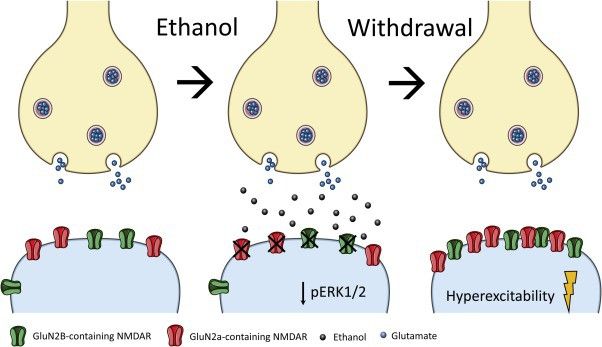
Image: Effects of alcohol withdrawal on NMDA receptors
rs2058878 is a single nucleotide polymorphism or SNP in the GRIN2B gene. The A allele of rs2058878 is associated with prolonged abstinence from alcohol during the first three months of Acamprosate treatment.
To avoid an overdose of the drug, the recommended dosage of Campral (Acamprosate Calcium) is two tablets of 333 mg each. However, a lower dose may be effective in some patients. This dosage is ideal for patients who eat three meals a day regularly.
Acamprosate is predominantly excreted by the kidneys. So, the risk of toxic accumulation and reactions to the drug is high in patients with impaired renal function and kidney disorders.
For patients with moderate renal impairment (creatinine clearance of 30-50 mL/min), a starting dose of one 333 mg tablet taken three times daily is recommended.
Acamprosate is not recommended in patients with severe renal impairment (creatinine clearance of ≤ 30 mL/min).
Since renal function decreases in elderly patients, appropriate dosage selection is crucial in the senior age group.
If you are pregnant or lactating, you must inform your doctor about the same before taking Acamprosate.
Campral is considered to be a Pregnancy Category C drug. Pregnancy Category C drugs are known to cause harm to the fetus in animal studies, but there is an inadequate number of studies on humans.
Acamprosate calcium was found to be teratogenic (causes fetal abnormalities and malformations) in animal studies. It also increases the risk of stillbirths.
These studies also report that acamprosate is released into breast milk. Though there have been no studies on humans to prove the same, it is best to inform your doctor if you are lactating before taking the medication.
A genetic test gives a deeper insight into how your body reacts to a particular drug. It can help your medical practitioner recommend the appropriate dose for you.
Analyze Your Genetic Response to Acamprosate
References:
The autoimmune regulator (AIRE) gene is crucial for distinguishing the body's cells from foreign cells. A recent study has found that the absence of the AIRE gene results in infertility problems in males. In addition, the study found that AIRE deficient infertile mice exhibited symptoms similar to an autoimmune disorder in men. The study further suggests that autoimmune diseases can impact fertility.
The AIRE gene provides instructions for making a protein called an autoimmune regulator. This protein is primarily expressed in the thymus, an organ located near the breastbone. The crucial function of this protein is to protect the body's cells from foreign invaders. The malfunction of this protein leads to a condition called autoimmunity (inability of the immune system to distinguish body cells and foreign cells, resulting in self-injury).
Male factors like ejaculation issues, inability to produce healthy sperm and dilated veins around the testicles have been estimated to contribute to infertility to a large extent. The absence of the AIRE gene is one of the determinant factors of infertility. A deficiency in this gene leads to the loss of proteins responsible for sperm production, resulting in infertility.
AIRE-dependent central tolerance is a process by which male fertility is protected by preventing autoimmune attacks on the reproductive targets. An impaired AIRE- dependent central tolerance could lead to male infertility.
Researchers began by mating AIRE deficient male mice and normal male mice with normal female mice.
The research study made the following observations in the AIRE deficient male mice
It was also found that AIRE deficient mice had low testosterone levels (male sex hormone), and that their immune system injured their reproductive organs, especially epididymis.
Researchers further made the following suggestions:

Abacavir is an oral medication used to treat infections associated with the Human Immunodeficiency Virus (HIV). It belongs to a class of drugs called reverse transcriptase inhibitors that prevent the multiplication of HIV. It is routinely used with other medications as part of Highly Active Antiretroviral Therapy (HAART).
HIV needs to form new DNA to produce new viruses and multiply. The virus uses an enzyme called reverse transcriptase (RT) to create the new viral DNAs in the host (humans, animals).
This enzyme is usually found in retroviruses like Human Immunodeficiency Virus or HIV.
When Abacavir is consumed, it gets converted into its active form called carbovir triphosphate in the body. This compound is similar to deoxyguanosine triphosphate, a compound used by the HIV virus to make new DNA.
The RT enzyme now uses carbovir triphosphate instead of deoxyguanosine triphosphate for making DNA. This interferes with viral replication, slowing down the multiplication of HIV.
Abacavir does not kill HIV and is not a cure for the disease either.
Some common side effects of Abacavir are:
Serious side effects of the drug include:
Abacavir shows interactions with other drugs, so it is essential to inform your doctor about the medications you may be taking. Some medicines that may interact with Abacavir are:
The HLA-B gene is a part of the Human Leukocyte Antigen (HLA) complex family. This complex helps the body’s immune system differentiate between proteins made by the body and infectious pathogens like bacteria and viruses.
There are many types of the HLA-B gene that allow the immune system to respond to a wide range of pathogens. The HLA-B gene alleles are numbered as HLA-B *x, where x is a numerical figure. For example, HLA-B*57, HLA-B*35, etc.
Closely related alleles that are categorized together are numbered as HLA-B *57: 01 to HLA-B*57:60 (if there are around 60 very similar alleles that are subtypes of HLA-B57)
HLA-B*57:01 allele increases the risk of hypersensitivity reactions to Abacavir across different ethnicities.
In addition, the presence of HLA-B*57:01 significantly increases the risk of hypersensitivity reactions with Abacavir usage.
Abacavir is, therefore, not indicated or prescribed for patients with HLA-B*57:01 allele and those with a prior history of hypersensitivity reaction to Abacavir.
rs2395029
rs2395029 is a single nucleotide polymorphism or SNP in the HLA-B gene. The G allele of this SNP is 99.9% predictive of the presence of an HLA-B*5701 allele in Caucasian and Hispanic populations.
| Genotype | Effect |
| GG | HLA-B*57:01 homozygote likely if the individual is Caucasian or Hispanic. High risk for hypersensitivity to drugs like Abacavir |
| GT | Most likely a carrier of the HLA-B*57:01 if the individual is Caucasian or Hispanic. |
| TT | No risk of sensitivity to abacavir |
Before taking Abacavir, you must inform your doctor if you have a history of liver or kidney problems.
Abacavir may increase your risk for heart attack, and you must consult your doctor if you have any cardiovascular condition that can precipitate an attack.
It is also essential to inform your doctor about your history of alcohol consumption, smoking, hypertension, diabetes, and high cholesterol levels.
If you are on medications like methadone or other retrovirals for HIV, you must inform your doctor and pharmacist to avoid untoward drug interactions.
The recommended dosage of Abacavir is 300 mg orally twice a day or 600 mg once a day (for healthy adults, adolescents, and children weighing at least 25 kg). The drug is available as a solution (20 mg/mL) and tablet (300 mg).
Before taking Abacavir, you must inform your doctor if you are allergic to the drug or have a history of allergies to any substance or other medications.
Inform your doctor if you are pregnant before starting on Abacavir. Treatment using this drug can lower the transmission of HIV to your fetus.
This drug can pass into breast milk. Therefore, avoiding breastfeeding may be recommended during treatment with the drug.
Screening for the HLA-B*57:01 allele is recommended for all patients according to the FDA drug label for Abacavir.
Analyze Your Genetic Response to Abacavir
Methadone is an opioid (or narcotic) drug and a controlled substance - this drug has a risk of misuse and may cause dependence.
Methadone is also available as the brand-name drug Methadose. It is used as an oral soluble tablet.
Methadone is used to treat moderate to severe pain.
It is sometimes prescribed in cases where the patient has an addiction to another opioid. Methadone helps prevent withdrawal symptoms.
Methadone relieves pain by changing the way your brain and the nervous system respond to pain. It does so by working on the pain receptors.
Methadone relieves pain much slower than other painkillers like morphine.
Some common side effects of methadone are:
Some serious side effects are:
Opioid medication can interact with many other drugs and cause dangerous side effects. Make sure you notify your doctor if you use other:
Methadone maintenance treatment is the use of methadone for a prolonged period of time to treat pain in patients who have faced addiction issues with other opioids like heroin.
The UGT2B7 gene is located at chromosome 4q13. It contains instructions for the production of UDP-Glucuronosyltransferase-2B7.
It is associated with withdrawal symptoms, treatment efficacy, and side effects in methadone maintenance treatment.
rs4292394
rs4292394 is a single nucleotide polymorphism or SNP in the UGT2B7 gene. It is associated with opioid withdrawal when undergoing methadone maintenance treatment.
| Genotype | Effect |
| GG | May have increased severity of opiate withdrawal symptoms |
| CG | May have decreased severity of opiate withdrawal symptoms |
| CC | May have decreased severity of opiate withdrawal symptoms |
The CYP3A enzymes are the most abundant of the CYP450 isozymes, comprising ∼40% of the hepatic CYP450 content.
The CYP3A4 gene contains instructions for the production of the Cytochrome P 450 3A4 enzyme. CYP3A4 plays a role in the metabolism of 40–60% of all drugs ingested.
A few studies have reported the role of CYP3A4 polymorphisms in methadone toxicity.
rs4646437
rs4646437 is an SNP in the CYP3A4 gene. Studies have demonstrated that the CYP3A4 enzyme expression and activity are increased in females carrying the T allele.
Increased levels of CYP3A4 result in increased conversion of methadone to inactive metabolites (substances that result from the metabolism of methadone). This increases the risk of fatal methadone intoxication in the female population with the T allele.
Notify your doctor of any health conditions you may have, like heart, lung, or kidney disease, as methadone may not be safe to consume in these cases.
Make sure your doctor knows all the drugs you are currently on/have had in the recent past in order to avoid drug interactions.
Women who are pregnant or breastfeeding may take methadone; however, methadone can cross the placenta and can go into the breast milk. So seek the advice of your medical practitioner if you are pregnant or breastfeeding.
The correct dosage varies according to the purpose - whether to treat pain, for detoxification of opioid addiction, or for maintenance of opioid addiction.
In case you take too much or experience symptoms of overdosing like slow pulse, cold, clammy skin, slowed breathing, or dizziness, immediately call your doctor or local poison control. If the symptoms are severe, call 911.
Methadone can cause severe allergic reactions. If you have trouble breathing or experience swelling of your tongue and throat, seek medical attention immediately.