As a parent, do you want to find out if your child carries the risk for attention deficit hyperactivity syndrome (ADHD)? Won’t this help you in supporting your child better? Most parents dismiss ADHD as a child being a little extra noisy or extra impulsive or overly talkative. Little do they realise that a simple task of putting on a pair of socks can be 10 times harder for children with ADHD, and these children will benefit from specialists’ support.
Nearly 5% of children and 2.5% of adults are estimated to have this condition, which means that 5 in 100 kids are not just over active but require support and intervention. A new genome wide association study (GWAS) published in Nature has identified genetic variants associated with the condition, which could be used to identify children at risk. Using data from 20,183 people with ADHD as case and data from 35,191 without the condition as controls, this study is one of the biggest and the most comprehensive for this condition.
ADHD risk variants identified
The study identified 304 risk variants from 12 genetic loci which were associated with mediating gene expression in the brain. These are genes involved in pathways associated with neuronal development, synaptic function, neurotransmitter regulation and other such important processes. These genes also overlapped with genetic loci associated with major depressive disorder and anorexia nervosa.
Replication analysis conducted using 23andMe data and Decode Genetics data
The most significant genetic associations identified by the study researchers were further subjected to replication analysis using data from tens of thousand of cases and controls and tested by direct to consumer genetic testing (DTC) companies like 23andme and Decode Genetics.
The researchers who carried out the study showed that there was strong concordance between the GWAS of ADHD and phenotypic signs, indicating the significance of genetic testing for ADHD.
A study conducted by 23andme has found that genetic variants are associated with a craving for cannabis. Cannabis or marijuana is a widely used psychoactive drug which is known to lead to craving and addiction among certain users. What if we had the ability to identify people who had an increased risk of craving? Couldn't this be used to prevent such people from getting addicted or used to ensure better monitoring of use? This may have seemed far fetched a few years ago, but a 23andme study has shown that genes may hold the clue with regards to addictive tendencies for cannabis.
The efforts that are focussed on reducing dependence to cannabis- also known as marijuana, hemp, hashish, ganja, bhang, charas, kif and more, require a better understanding of why some people require it while others don't. For some people, marijuana has the ability to transform the mundane into excitingly delightful, leading to increased dependence and craving.
Like many of the psychoactive drugs that are available today, cannabis acts by changing the rate of an existing pathway in the brain. The active ingredient in cannabis - delta 9 tetrahydrocannabinol (THC), mimics the body’s own endocannabinoids, activating the same pathways associated with emotions, thoughts and experiences.
The cannabinoid receptors are used in a judicious way by the body, to sieve through the endless stream of information and to flag the ones that are ‘exciting’. However, marijuana, as opposed to select synapses, makes everything ‘exciting’- even the most boring and mundane task. People on a cannabis ‘high’ can revel in a task as simple as sitting on a couch for hours.
Imagine a farmer watering an already flooded field, chronic use of cannabis does exactly that! In order to overcome the excess, the body dampens the intrinsic machinery.
Chronic exposure removes the ability to value experiences that warrant it.
As cannabis is now legal in many states in America and Canada, it becomes imperative to differentiate between people who may get addicted and who may not. Widespread addiction can have socio-economic impact on societies where cannabis is free available. Additionally, knowledge of intrinsic addictive tendencies can perhaps inspire or caution the individual, thereby leading to self-regulation of use.
The 23andme study on cannabis craving used data from 180,000 people to find an association between certain genetic variants and the risk for craving. The study found that people who are more prone to be ‘lifetime users’ of cannabis were also more likely to develop schizophrenia and attention deficit hyperactivity disorder(ADHD). The study does state, though, that these genetic factors could contribute to only 11% difference in cannabis use between people.
Check your 23andMe or Ancestry DNA raw data to know rs806380 variants
| Genotype | Phenotype |
|---|---|
| [Advantage] More likely to have decreased risk of cannabis dependence |
|
| CT | More likely to have moderately decreased risk of cannabis dependence |
| TT | Normal |
Genetic testing costs are now lower than ever before, allowing many people to access their genetic data. Though genes are only one part of the puzzle, identifying the genetic predisposition will help in understanding preferences independently of environmental factors.
Would you like a cup of tea or coffee? This is probably the most asked question at ‘tea time’, however, the answer to that could lie, in part, in our genes. Scientists from The Northwestern University carried out a study that showed that genetic predisposition to bitter taste perception may play a role in whether we prefer tea or coffee.
The study was published in the Journal Scientific reports and included data from over 400,000 UK adults of largely European ancestry between the ages of 37 and 73 years. The study highlighted that people with certain receptors for the bitter taste of coffee were less likely to drink tea and more likely to drink more than four cups of coffee.
There were three variants in genes that were studied by the researchers. One was associated with perception of bitterness of caffeine, of quinine (found in both tea and coffee) and in the synthetic molecule propylthiouracil (PROP).
Do you prefer coffee? The study showed that individuals who had increased sensitivity to quinine and PROP, as identified by their genetic variants, were less likely to prefer coffee. In short, the genes that increased sensitivity to bitter taste in cruciferous vegetables like brussels sprouts, were also less likely to drink coffee. Such people preferred tea to coffee.
Coffee drinkers had an increased sensitivity to the bitterness of caffeine.
This brings us to the question, how do some people with increased sensitivity to another bitter taste, caffeine, prefer coffee? Shouldn’t they be put off by the taste of caffeine? The study researchers believe that people probably associate caffeine with the ‘buzz’ that they get from coffee. The psychostimulant effect of caffeine helps coffee lovers associate caffeine with the ‘good things’. The ability to taste caffeine better makes them drink more than 4 cups of coffee everyday or places them at 20% higher risk of becoming heavy drinkers.
Another takeaway from this study is that people who have increased sensitivity to bitter taste PROP are less likely to prefer coffee and more likely to prefer tea. This could be due to the fact that tea has lesser bitter compounds than coffee. So, if coffee is too much to handle, then tea it is.
Low cost of genetic testing has allowed many people to access their genetic data. Though genes are only one part of the puzzle, identifying the genetic predisposition will help in understanding preferences independently of environmental factors.
There is one more reason for morning people to feel smug about, a new study has found that they have a lower risk of breast cancer! If you don’t already know what type of a person you are, DNA raw data can now be used to find out if you are morning person, a night owl, your entrepreneurship potential and even how empathetic you are likely to be.
A University of Bristol study has shown that people who are early risers are more likely to have lower risk of breast cancer, after sieving through the data of hundreds of study participants. The study is of significance to women, their sleep patterns and their risk of developing breast cancer.
Everybody has a natural ‘body clock’ or a circadian rhythm, which is associated with our sleep patterns, our mood and energy levels. Morning people are those who get up early and feel more energized during the morning hours while night owls tend to stay awake till late into the night and get up late.
People with certain genetic variants are associated with being early risers and are found to have better focus and attention during the morning hours. But, how and why did the morningness and night owl tendencies originate in humans?
Variations in genes are associated with selection pressures caused by certain environmental factors, and for these personality traits, it was caused by the sentinel adaptation. During prehistoric times, it was important for certain members of a tribe to stay awake and keep a watch for danger as the rest of the tribe slept, this helped in safeguarding the tribe from predators.
Anthropologists studied sleep patterns among the Hadza people of Tanzania who continue to live like hunter-gatherers. These people were provided with specific fitbits that monitored their sleep patterns. It was found that about 40% of the group stayed awake at any given time and the entire group slept at the same time for only 18 minutes during the 200 hours study period!
40 to 70% variation in sleep patterns is found to be genetic, so an understanding of the genetic variants carried will help in identifying the likely personality trait.
The University of Bristol study has shown that there is a 40 to 48% reduced risk of breast cancer among women who are morning people.
If you thought that you could sleep out your breast cancer risk, well think again. The same study has shown that sleeping for longer periods, longer than required, could increase the risk for breast cancer by 20% for every excess hour.
Sleep duration also varies between individuals, with genetics playing a role. To find out more sleep duration needs and if you are a morning person or night owl, buy Xcode’s personality trait report here.
Here is some refreshing news for pregnant mothers, babies who get sufficient Zinc during the early stages of development have a lowered risk of autism. Autism is known to be caused by a combination of genetic factors and environmental factors, a new study shows that zinc could be one of them.
The study conducted by Stanford University School of Medicine has identified a possible mechanistic link between Zinc deficiency and autism. Zinc, according to the researchers, shapes the synapses or the connections between the brain cells that are formed during the early stages of development.
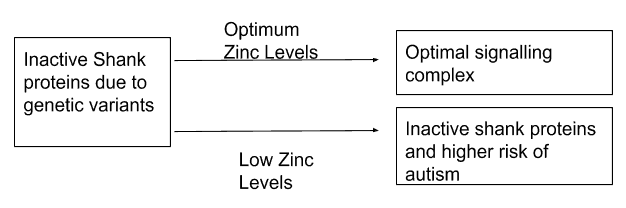
Autism is associated with specific genetic variants that are involved in the formation, maturation of synapses during the early stages of development. The zinc levels interact with the proteins that are encoded by these genes, possibly leading to autism.
Such epigenetic variation in gene expression has brought to the fore the importance of nutrition in the developing foetus. Other examples of epigenetic influences on autism risk include the presence of ethyl mercury in vaccines and the presence of toxic elements like cadmium, mercury and arsenic.
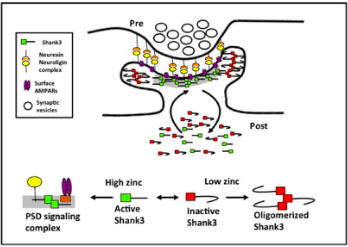
The hedgehog signalling pathway refers to the signalling pathway associated with information transmission to developing embryonic cells for proper differentiation. Shank proteins are important scaffold proteins in the hedgehog signalling pathway, which are known to connect neurotransmitter receptors as well as ion channels to the actin cytoskeleton and G-protein-coupled signaling pathways. These proteins that are associated with the maturation of adjacent signal receptors called ‘AMPAR’ during the early stages of development. Genetic variations in genes that code for Shank proteins are associated with autism as they result in inactive Shank 2 and Shank 3 proteins.
Hand-Picked article for you: Worrier Or Warrior? Analyze Your DNA Raw Data For COMT – The Warrior Gene
Zinc binds to these Shank proteins, which results in changes in composition and maturation of AMPAR signalling. This study provides a molecular link between Zinc supplementation and risk of autism, however, the study was not conducted on pregnant women to verify this information.
Zinc is an important micronutrient which is associated with the metabolism of fats, proteins and carbohydrates form the food and also in the synthesis of new cells and enzymes.
Foods rich in zinc include dairy foods, meat and shellfish. People of certain genetic types require increased amount of zinc in their diet.
An excess of zinc could affect absorption of copper and result in the development of anemia and bone weakening. An understanding of a risk for autism will help in modifying diet and lifestyle to lower risk for the condition.
Find out your genetic risk for autism by getting Xcode’s health report.
Insights into the body’s detox ability may be determined by uploading DNA raw data from genetic testing companies like 23andMe to identify the GST gene variant carried. The GST genes are responsible for synthesizing and recycling glutathione.
The glutathione/GST system is one of the body’s most important detox mechanism, which lowers oxidative stress and plays an important role in DNA repair, immunity and detoxification of chemicals, metals and estrogens.
The enzymes that belong to the family of glutathione S-transferase (GST) and cytochrome P450 (CYP) families are associated with a two-stage detoxification process for multiple toxins and potential carcinogens. Phase I enzymes act on most potentially toxic compounds and then these activated metabolites undergo detoxification by phase II enzymes, especially GST.
There are eight classes of the GST enzyme, from alpha to zeta (names GSTA, GSTM etc). These enzymes detoxify toxins by adding a glutathione and are found mainly in the liver but are also found in other parts of the body like the intestine. [/vc_column_text][vc_separator color="white" el_width="50"][vc_single_image image="34148" img_size="large" add_caption="yes" alignment="center"][vc_separator color="white" el_width="50"][vc_column_text]
Any toxin that has been conjugated with glutathione by the GST enzyme is then removed from the body in the urine or in the bile.
Research studies have shown that phase I and phase II gene polymorphisms are associated with the risk for the following diseases
Here are a few common polymorphisms in the GST gene that are associated with the level of glutathione transferase activity. To find out the inherited variant of GSTM1 23andme DNA raw data is all that is required. There are extensive pubmed entries for GST polymorphism and their associated disease risk.
Check your 23andMe raw data or Ancestry DNA raw data to identify which variant of rs366631 you carry.
| Genotype | Phenotype |
|---|---|
| AA | More likely to have lower enzyme activity |
| GA | More likely to have normal enzyme activity |
| GG | More likely to have normal enzyme activity |
Check your 23andme raw data or ancestry DNA raw data to identify which variant of rs3957357 you carry.
| Genotype | Phenotype |
|---|---|
| AA | More likely to have lower enzyme activity |
| GA | More likely to have normal enzyme activity |
| GG | More likely to have normal enzyme activity |
Check your 23andme raw data or ancestry DNA raw data to identify which variant of rs1695 you carry
| Genotype | Phenotype |
|---|---|
| AA | More likely to have normal enzyme activity |
| GA | More likely to have reduced enzyme activity |
| GG | More likely to have reduced enzyme activity |
There are genetic testing services like Genetic Genie detox profile which lists even GSTT1 null alleles that are present in the 23andme raw data. However, the genetic genie detox profile interpretation does not include recommendations that Xcode Detox profile does.
References: