
Estimated reading time: 6 minutes
Key Takeaways
- Habit stacking is a behavioral strategy that links a new habit to an existing routine.
- It is based on cue-based learning and reinforcement principles.
- Research suggests repetition increases automaticity, but timelines vary widely.
- Individual differences influence how quickly habits become consistent.
What Is Habit Stacking?
Habit stacking is a behavioral technique in which a new habit is attached to an existing routine.
The term was popularized by James Clear in Atomic Habits.
However, the underlying concept is rooted in behavioral psychology and associative learning.
The primary goal of habit stacking is to tie small, repeatable, and beneficial habits to existing ones.
How Does Habit Stacking Work?
Habit stacking relies on cue-based behavior.
This reduces the need for conscious decision-making.
Over time, repetition may increase automaticity.
- You use an existing habit as a trigger so that the new habit feels automatic rather than something new, which you may tend to skip or miss
- Piggybacking new habits on existing ones can reduce decision fatigue and the mental effort required to remember them.
- Over time, the brain begins to link the two habits, making the new habit part of the same neural pathway as the old one.
| Expert picks: What To Read Next |
|---|
| How To Get Rid Of Brain Fog? |
| What Are Some Simple Tests You Can Do To See If You’re Aging Well? |
What Is the Science Behind Habit Stacking?
The main science behind habit stacking is that our brains thrive on patterns and routines.
This is why a simple task like brushing first thing in the morning feels automatic, not like a task
Habit formation is associated with neural processes involving the basal ganglia, a brain region linked to routine behaviors.
Repeated behaviors require less cognitive effort over time.
A widely cited study found that automaticity for simple health behaviors developed over a median of 66 days, with substantial variation between individuals.
Habit stacking aligns with associative learning principles, where one cue becomes linked to another behavior.
Reward-based reinforcement mechanisms also play a role in maintaining repetition.
The Habit Loop Framework
To understand how habit stacking works and make it a ritual, you must understand these four stages:
- Cue: The first thing to do to begin the process. For example, get out of bed and walk to the bathroom.
- Craving: This is your motivation (what drives you) to do something based on the cue. In this case, the need to brush your teeth to clean your mouth.
- Response: The habit you form, like brushing your teeth
- Reward: What you gain from the cue, such as a clean mouth and breath.
What Are Some Examples Of Habit Stacking?
There can be several examples of habit stacking in daily life. For example:
- You floss around your teeth after brushing in the morning
- You pour yourself a cup of coffee and meditate for two minutes every morning
- You get into bed and read one page of a book every night
- After taking a bath, take one minute to practice deep breathing
- Sending your loved ones one message of gratitude after logging off from work every day
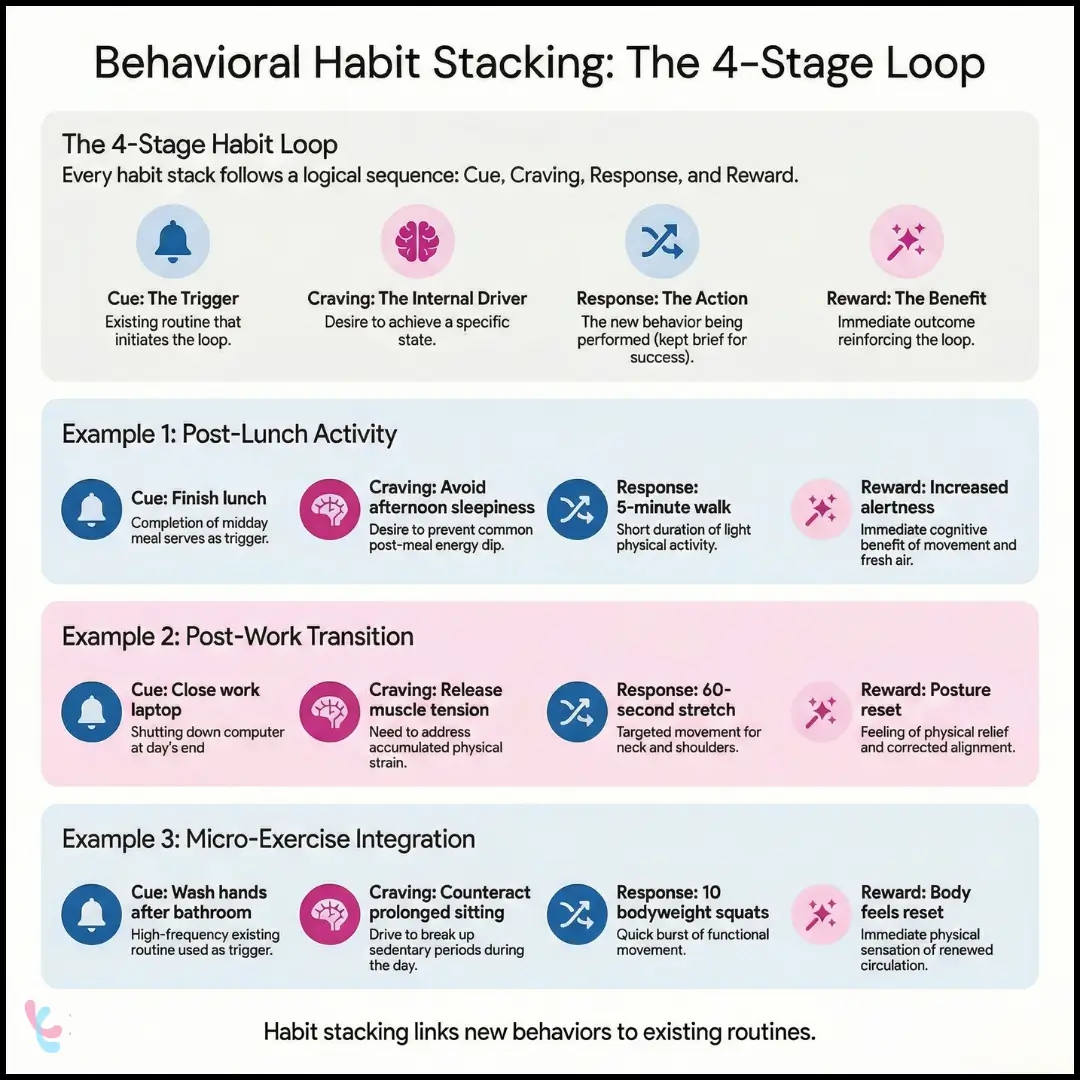
Why Habit Formation Varies Between People
Habit formation timelines differ.
Research suggests factors such as stress, sleep, motivation, and reward sensitivity influence automaticity.
Emerging behavioral genetics research indicates dopamine signaling pathways may influence reinforcement sensitivity.
This does not mean habits are genetically determined.
It suggests variability in how reinforcement systems respond.
Common Mistakes in Habit Stacking
- Using inconsistent anchor habits
- Stacking multiple new habits simultaneously
- Choosing high-effort behaviors
- Not reinforcing repetition
How Habit Stacking Can Be Structured
Habit stacking tends to be more sustainable when the anchor behavior is consistent and predictable.
1. Choose a Reliable Anchor Habit
The anchor habit should already occur daily with minimal variation. For example, brushing teeth or making coffee.
Behavioral research suggests that consistent cues strengthen repetition patterns.
2. Define the New Behavior Clearly
Specific behaviors are easier to repeat than vague intentions.
For example:
“Practice deep breathing for two minutes after showering” is more concrete than “Be more mindful.”
Clarity reduces ambiguity and improves follow-through.
3. Start With Low Effort Behaviors
Habits requiring minimal effort are more likely to be repeated.
Research on habit formation suggests that complexity influences the timeline for automaticity.
Smaller actions may integrate more smoothly.
4. Monitor Repetition Patterns
Tracking does not create habits directly. However, visible repetition can reinforce awareness and consistency.
Behavioral monitoring is commonly used in cognitive behavioral interventions.
5. Reinforcement and Reward
Reinforcement mechanisms influence repetition. This does not require large rewards.
Even small acknowledgments can strengthen the cue-response connection through reward-based learning
Frequently Asked Questions About Habit Stacking
Habit stacking is grounded in established behavioral science principles such as cue-based learning and reinforcement. While there are no large randomized controlled trials specifically on “habit stacking” as a branded method, research on habit formation and associative learning supports the idea that linking behaviors to stable cues may improve repetition. Effectiveness varies depending on the complexity of the habit and the consistency of the anchor behavior.
Habit stacking may be less effective if multiple new behaviors are added at once or if the anchor habit is inconsistent. Complex or high-effort behaviors may require additional motivation beyond simple cue pairing. It also does not produce rapid behavioral change; repetition over time is required for automaticity to develop.
The 3-3-3 rule is a productivity framework rather than a clinically validated behavioral model. One interpretation suggests building a habit over three days (initiation), three weeks (consistency), and three months (integration). Another version refers to dividing daily time into three blocks of focused work. There is limited scientific evidence supporting this specific structure, although gradual progression aligns with behavior change theory.
There is no fixed timeline. A frequently cited observational study found that simple health behaviors reached automaticity in a median of 66 days, with a range from 18 to 254 days depending on the individual and the behavior studied . More complex habits may require longer repetition.
Yes. Habit stacking may not lead to consistent repetition if the anchor habit is irregular or if the new behavior requires substantial effort. Stress, competing priorities, and lack of reinforcement can also interrupt habit formation. Behavioral change is influenced by both environmental and individual factors.
Final Takeaway
Habit stacking is a structured way to build consistency by linking behaviors together. Its effectiveness depends on repetition, cue reliability, and individual variability. There is no universal timeline. Consistency and realistic expectations are central to long-term habit formation.
References
https://jamesclear.com/habit-stacking
https://jamesclear.com/habit-stacking
https://news.vcu.edu/article/building-new-habits-with-mindful-habit-stacking
https://www.heart.org/en/healthy-living/healthy-lifestyle/habits/habit-stacking-for-success
https://health.clevelandclinic.org/habit-stacking
https://www.healthline.com/health-news/wellness-stacking-self-care-trend-healthy-habits
https://pmc.ncbi.nlm.nih.gov/articles/PMC9880255
https://pmc.ncbi.nlm.nih.gov/articles/PMC4826769