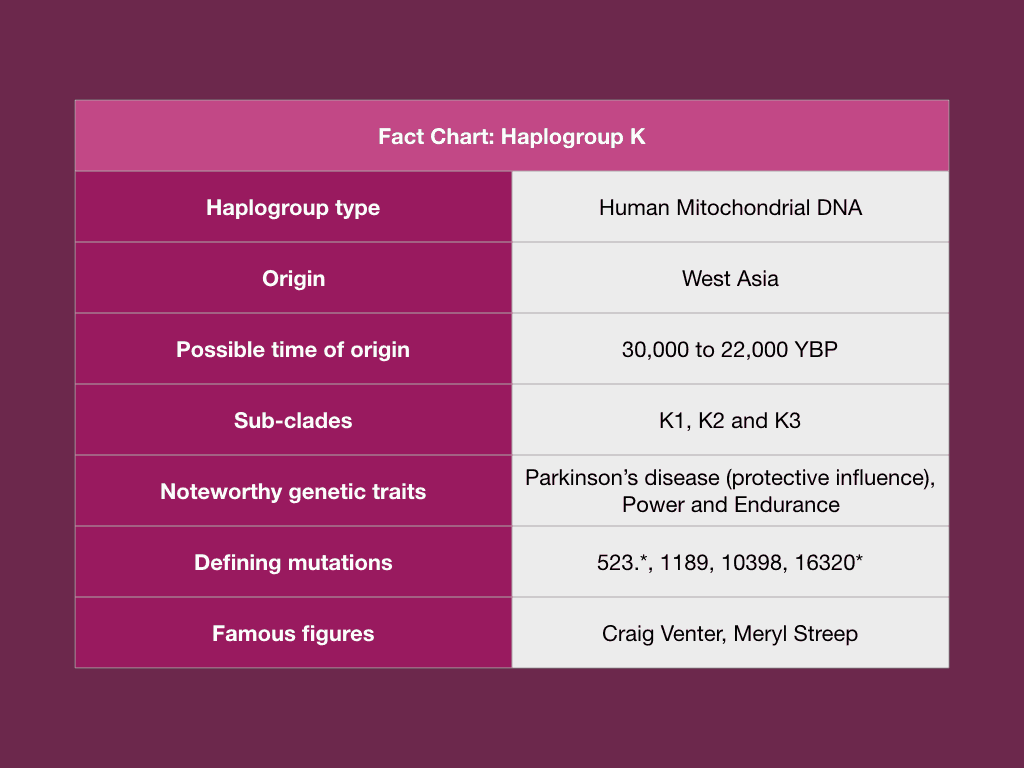
Haplogroup K is a mitochondrial haplogroup (mtDNA haplogroup) that is estimated to have originated during the Upper Paleolithic or Late Stone Age around 30,000 to 22,000 ybp. The most common sub-clade of this haplogroup is U8b. According to a study conducted in a Caucasian population, individuals who were found to be classifed under haplogroup K showed a significantly lower risk toward Parkinson’s disease as compared to individuals assigned the haplogroup H.
Important! Remember to check your raw data for Y-DNA (if you are male) and mt-DNA markers. Your autosomal DNA raw data is not enough for haplogroup analysis.
The geographical distribution of Haplogroup K ranges from Northwest Europe to regions of the Eastern Mediterranean and the Middle East. The highest frequencies of Haplogroup K was found to be in Belgium, The Netherlands, Cyprus and Lebanon.
Haplogroup K was found to have originated in West Asia between 20,000 and 38,000 ybp as a sub-clade of U8b. Sub-clades of haplogroup have their origins in different regions. For example, the sub-clades K1a, K1b and K2a were discovered among the Early Neolithic farmers from the Near East. At the same time sub-clades K1c, K2b and K2c were found among the Neolithic farmers who do not have any Near Eastern roots. Today, this haplogroup is most common among eastern Europe and is postulated to have spread to regions of Germany and Central Asia during the Bronze Age along with Y-Haplogroup R1a.
Interesting trivia: According to the book The Seven Daughters of Eve by Bryan Sykes, the originator of Haplogroup K was given the name Katrine.
Haplogroup K is the most common haplogroup among the Ashkenazi Jewish population. The highest percentage of lineages from this population that belong to haplogroup K. Using ancient mtDNA samples of Neolithic farmers, it was found that around, around 15% of these samples belong to haplogroup K. As these farmers mingled with the aboriginal Europeans descended from Mesolithic fishermen and hunter-gatherers the frequency of this haplogroup decreased.
The K1a sub-clade of this haplogroup is estimated to have originated 19,000 to 22,000 ybp. Among the K haplogroup sub-clades, this is the most common in Europe. This includes regions of Spain, Catalonia, Portugal, Hungary and Sweden. K1a is also predominant in the Levant mostly among the Druzes. The Druze population is known to be the closest population to the original Neolithic farmers. They are also said to be constituting the early populations of the Levant before the Arabic expansion. The Druze population have 13% frequency of haplogroup K with sub-clade K1a being the most prevalent.
Get your Origin 2.0 Ancestry report and find out your Haplogroup!
A 2009 study by Rollins et al, showed an association between mitochondrial DNA (mtDNA) alleles and the brain. The mutation A10398G which defines K1 was found to be associated with increased pH. An increased brain pH was found to protect individuals against Parkinson’s disease, schizophrenia, bipolar disorder and depression.
Studies conducted on elite athletes from the Finnish population showed that haplogroup K was not found among any of the endurance athletes (Niemi and Majamaa, 2005). Another study involving 395 elite Polish athletes- 213 endurance and 182 power and 413 sedentary individuals as control demonstrated an underrepresentation of haplogroup K among the athletes as compared to the controls.
23andme celiac disease genetic testing involves assessment of genetic markers associated with gluten sensitivity and celiac disease from your 23andme raw data. The DNA raw data is available to you when you buy the 23andme genetic test for Ancestry.
In recent years, the number of people found to have celiac disease has grown many folds due to increased awareness and ease of diagnosis.
So, why do you need to do genetic testing for coeliac disease? About 1 in 100 people in the U.S have celiac disease. However, 2.5 million people with celiac disease do not know that they have it, i.e they are undiagnosed.
Here are a few important facts about celiac disease genetic testing that everyone must know.
| Celiac Disease | Gluten Intolerance |
|---|---|
| Rare condition. Only 1% of the population is known to be affected with this condition. | Compared to celiac disease, gluten intolerance is more prevalent. |
| This is an autoimmune condition and it involves the immune system. | This is not an autoimmune condition and it does not involve the immune system. Symptoms of gluten intolerance or gluten sensitivity are restricted to abdominal discomfort |
| The only treatment is to completely avoid gluten in the diet | The amount of gluten consumed should be below the body's threshold level. |
| This is a more severe condition | This is less severe when compared with celiac disease |
| Genotype HLA DQ 2.5 (rs2187668) | Phenotype |
|---|---|
| CC | [Advantage] More likely to be gluten tolerant |
| CT | Moderate risk for gluten intolerance |
| TT | [Limitation] More likely to be gluten intolerant |
| Genotype | Phenotype |
|---|---|
| AA | [Advantage] More likely to be gluten tolerant |
| AG | Moderate risk for gluten intolerance |
| GG | [Limitation] More likely to be gluten intolerant |
| Genotype | Phenotype |
|---|---|
| rs2395182- T | [Limitation] More likely to be gluten intolerant |
| rs7775228- G | [Limitation] More likely to be gluten intolerant |
| rs4713586-A | [Limitation] More likely to be gluten intolerant |
| Genotype | Phenotype |
|---|---|
| GG | [Advantage] More likely to be gluten tolerant |
| AG | Moderate risk for gluten intolerance |
| AA | [Limitation] More likely to be gluten intolerant |
References:
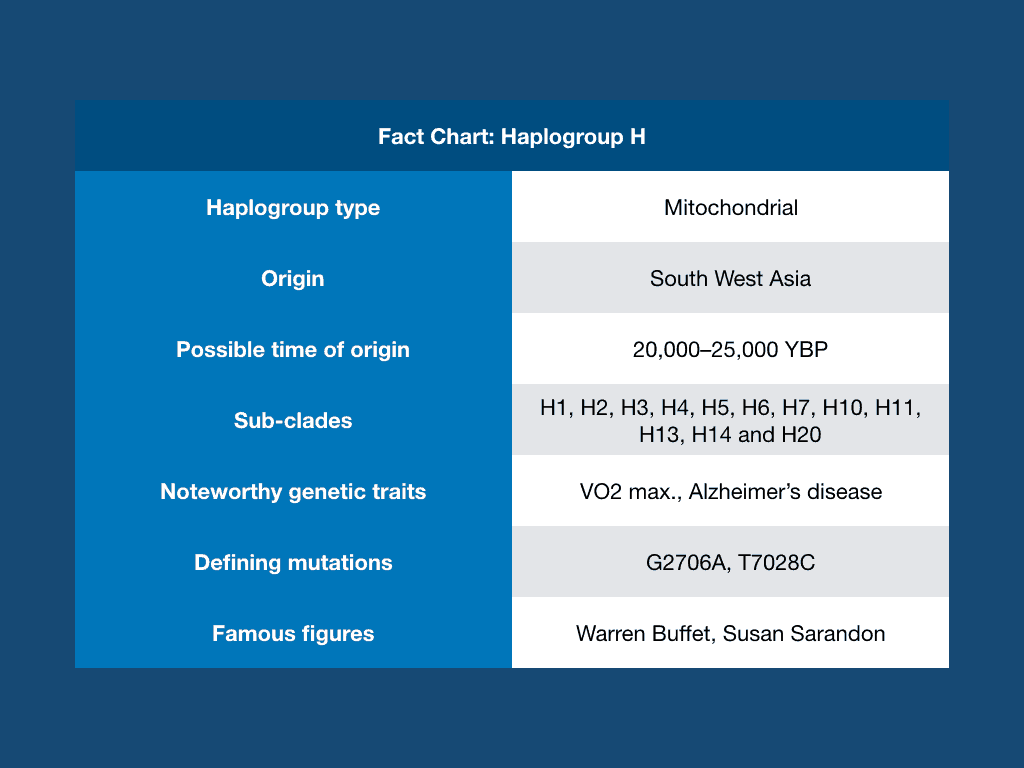
Haplogroup H is the most common and diverse haplogroup among the European populations. The frequency of this haplogroup in Europe ranges between 40-50%. High frequencies of this is haplogroup have been found in Wales and parts of Western Europe. The lowest frequency was found in Cyprus and Finland.
Studies have found that the Haplogroup H originated around 20,000 to 25,000 ybp probably in northeastern Mediterranean region. This haplogroup expanded into the Near East and Southern Caucasus as human populations migrated there between 33,000 and 26,000 ybp. As populations further migrated from the Iberian peninsula, this clade is estimated to have reached Europe before the Last Glacial Maximum.
Studies on Haplogroup H were possible using a few ancient mitochondrial DNA (mtDNA) sequences. These mtDNA sequences were found to belong to the populations that recolonised Europe from the refugia of France, Iberian Peninsula, Italy, the Balkans and the Pontic Steppe after the Last Glacial Maximum, around 26,500 to 19,000 ybp. Modern studies on the distribution of Haplogroup H1 and H3 support the this proposition.
Another piece of history that shows that haplogroups H1 and H3 may have come from the Neolithic farmers from the Near East. This is from a 5000 year old site of Treilles in France. About 17 mitochondrial DNA sequences that were retrieved from this site included three that belonged to haplogroup H1 and three to haplogroup H3.
Other subclades of haplogroup H were may have originated among the Mesolithic or Late Upper Paleolithic Europeans. Though the amount of data available is meagre, the minor subclades of Haplogroup H like H4, H10, H17 and H45 seem to have some kind of an exclusivity in Europe. For example the haplogroup H4, that is found among present day Basque and Sardinian populations was found in Neolithic Spain. Moreover the Basque and Sardinian populations are also known for high percentage of mixed Mesolithic and Neolithic European ancestry.
Haplogroup H is also distributed in North Africa and the Middle East. [/vc_column_text][vc_single_image image="59976" img_size="medium" add_caption="yes" alignment="center"][vc_column_text]
1. Maximum oxygen uptake (VO2 max.)
Haplogroup H was found to be associated with higher maximum oxygen uptake (VO2 max) (Martinez-Redondo et al, 2010). This means that individuals with haplogroup H have greater physical endurance and are more likely to benefit from protracted exercise hours. According to a 2014 study on Polish athletes, the haplogroup H was shown to have the maximum frequency among endurance athletes preparing for elite tournaments like the Olympics (Marsuzak et al, 2014.)
Get your Origin 2.0 Ancestry report and find out your Haplogroup!
The two polymorphisms that were found to be associated with elite endurance performance were 16080G that defines haplogroup H12b and 16362C that defines haplogroup H1B1.
2. Alzheimer’s disease
The defining mutation in haplogroup H5A was shown to have the highest predisposition risk for late onset Alzheimer’s disease (Santoro et al, 2005). On the other hand mutations associated with haplogroups H6A1A and H6A1B have been found to have protective effects against Alzheimer’s disease (Ridge et al. 2012).
Vitamin A is important for good vision, healthy eyes, healthy skin, and to fight infections.
Yet, it cannot be synthesized by the body.
Therefore, it becomes an essential nutrient that needs to be included in the diet.
Conversion of beta carotene to vitamin A is an important metabolic pathway which is genetically influenced.
Vitamin A refers to the interconvertible compounds retinal and retinol.
Both these can be converted into various other metabolites that are functionally important.
The transformation into these metabolites is irreversible.
Retinoic acid is one such metabolite.
Foods like milk, liver, fish oil, and eggs contain preformed vitamin A.
Beta carotene found in carrots and green leafy vegetables can be converted in the body into vitamin A, an important source for vegetarians.
Beta carotene is an ideal provitamin A carotenoid, and it needs to be converted into active vitamin A in the body.
Carotenoids are found in plants, and they are responsible for the distinct colors that some fruits and vegetables boast of.
Carrots get their orange color because of beta carotene.
According to the National Institute of Health, the following are the recommended units for the daily intake of beta carotene:
Once it is consumed, beta carotene is converted into vitamin A, which is then utilized by the body for various functions.
It is estimated that nearly 50% of vitamin A in a diet is due to beta carotene and other such carotenoids.
The major organs that are associated with beta carotene conversion are the liver and the intestines.
The liver is associated with storing significant proportion of retinoid.
There are two enzymes associated with beta carotene conversion to vitamin A, including:
Converting beta carotene to vitamin A is extremely variable with the estimated number of low responders to dietary beta carotene as high as 45%.
Genetic variants in the BCMO1 gene are associated with the conversion of beta carotene into retinol.
Check your Ancestry DNA or 23andMe raw data results for SNP rs7501331 that you carry
| Genotype | Phenotype |
|---|---|
| TT | [Limitation] Likely reduced beta carotene conversion |
| CT | [Limitation] Likely reduced beta carotene conversion |
| CC | [Advantage] Likely normal beta carotene conversion |
Check your Ancestry DNA or 23andMe raw data results for SNP rs12934922 that you variants
| Genotype | Phenotype |
|---|---|
| TT | [Limitation] Likely reduced beta carotene conversion |
| AT | [Limitation] Likely reduced beta carotene conversion |
| AA | [Advantage] Likely normal beta carotene conversion |
Enzyme activity based on genetic variant carried
A study by researchers from Newcastle University showed that individuals who carry the T allele of rs7501331 have a 32% reduction in enzyme activity while individuals who carried T allele for both rs7501331 and rs12934922 had a 69% reduction in enzyme activity.
A more recent study by researchers from the same university showed that apart from these two genetic variants in the BCM01 gene, there were other variants that had an influence on enzyme activity.
Other variants of interest are rs11645428, rs6420424, and rs6564851.
Vitamin A is important for vision and is used in the treatment of cataracts and age-related macular degeneration.
It is also important for the skin and immune system.
Vitamin A deficiency is major public health across the world. Each year, approximately 250,000–300,000 vitamin A-deficient children become, and half of them have been reported to die within a year after getting blind.
The following are some of the symptoms of vitamin A deficiency:
Hand-picked content for you: Genes can Influence your Vitamin A requirement- Here’s how
Beta carotene is considered pre-vitamin, but it also is known to have certain benefits.
Each carrot is known to contain about 10 - 50 mg of beta carotene, apart from other nutrients.
The following are some of the foods rich in beta carotene
| Range mg/100 g | β-Carotene |
|---|---|
| 20 -50 | Red peppers, carrot and paprika |
| 10 -20 | Carrots, red peppers |
| 5 to 10 | Acai berry drink, carrot juice, carrots, chili powder, kale, parsley pumpkin, spinach, turnip greens |
| 1 to 5 | Apricots, broccoli, cabbage Chinese, cherries, chicory greens endive, lettuce (green and red leaf), melons, oregano, parsley peas green, peppers green, plums, pumpkin, sweet potato, thyme, watercress |
Excess of retinoids is known to lead to teratogenic effects.
High levels of beta carotene are known to increase the risk for certain types of cancers.
One study found that there was an increased risk of lung cancer after β-carotene supplementation among smokers and people who drank more than 11 g ethanol/d.
High levels of beta carotene can affect the skin and lead to a condition known as carotenodermia.
The soles of the feet and the palms turn yellow.
Too little beta carotene or too much both have their share of risk, which makes genetic testing for vitamin A needs important.
How well your body converts beta carotene into retinol or vitamin A will help you identify the amount of beta carotene that should be consumed, from the diet or as a supplement.
Upload your 23andme raw data or any other ancestry raw data to avail Xcode Life’s Gene Nutrition Report can be used to identify your vitamin A needs.
| CHIP Version | Vitamin A SNPs |
| 23andMe (Use your 23andme raw data to know your DRD2 Variant) | |
| v1 23andme | Present |
| v2 23andme | Present |
| v3 23andme | Present |
| v4 23andme | Present |
| V5 23andme (current chip) | Present |
| AncestryDNA (Use your ancestry DNA raw data to know your DRD2 Variant) | |
| v1 ancestry DNA | Present |
| V2 ancestry DNA (current chip) | Present |
| Family Tree DNA (Use your FTDNA raw data to know your DRD2 Variant) | |
| OmniExpress microarray chip | Present |
Updated 21st June, 2021
Amazon has become the go-to platform to purchase DNA ancestry and health tests and reports. This could be attributed to many factors including the credibility that this platform has managed to establish over the years. Let’s look at some of the reasons why.
A recent survey showed that Amazon reviews are so trusted that consumers consider it as trustworthy as a personal recommendation from a friend or relative. Amazon is known to value this reputation and has taken proactive measures to prevent spurious reviews from bots. For example there is a weekly cap on the number of reviews that can done for the same product.
Among the first to initiate sales on the website was Ancestry DNA. Ancestry DNA started offering a DNA test for lineage and family connections through the marketplace in 2015. At that time, the company was selling 400 to 500 sets a day, a number that rose to close to 1,300 a day by late 2016. Ancestry DNA’s presence on Amazon certainly has contributed in augmenting the trust factor among consumers. Following Ancestry DNA’s move other big companies like 23andMe, Xcode Life, Vitagene, Family Tree DNA have now listed their products on this forum.
Amazon offers a wide variety of products and discounts relating to genetic tests ranging from ancestry to nutrition reports. Moreover consumers have the option to scan several options from a single website for the best deal without having to browse multiple websites.
Amazon has a way of locking in customers. Attractive features like low shipping fee, Amazon Prime membership, has led to customers flocking to this e-commerce giant.
Amazon’s Frequently Bought Together information section gives the buyer an idea as to which tests are the most preferred by fellow consumers.
Below we list some of the best value products and combos on Amazon.com
Remember to checkout this page on a regular basis or signup to our newsletter to receive the latest information on products, deals and discounts on amazon.com
DNA-testing companies that offer everything from ancestry information to tests for common inherited diseases had record sales in 2017 holiday season. And Amazon is now serving as a new marketplace for many of them.
You can now use your DNA raw data from ancestry genetic testing companies like 23andMe, Ancestry DNA, Family Tree DNA etc through Amazon.com to get reports on Nutrition, Fitness, Health, Allergy and Skin from Xcode Life.
Step 1: Place an order from here
Step 2: Send your Amazon order ID through the contact form here: https://www.xcode.life/contact-us/ using an active email address
Step 3: An Xcode Life account will be created. And your credentials will be sent to your registered email address.
Step 4: Upload your raw data to your account
Step 5: You will receive your results in 24 hours.
The COMT gene codes for the production of catechol - O -Methyltransferase enzyme. This enzyme is associated with degrading neurotransmitters, transfering methyl groups to epinephrine, norepinephrine and dopamine ( catecholamines).

By uploading DNA raw data from 23andme COMT gene variant carried may be determined ,which can also be used to identify tendency for specific personality traits.
The COMT enzyme is also associated with the breakdown of certain drugs prescribed for hypertension, Parkinson’s disease and asthma.
The following processes are associated with the COMT variant under study.
Catechol estrogens- role in cancer
The catechol estrogens are associated with hormone regulation and can have a potent endocrine effect. The hormones that may be affected by these catechol estrogens include prolactin, luteinizing hormone and follicle stimulating hormone.
Estrogens are known to lead to cancer by encouraging proliferation of cells and resulting in damage. These hormones are found to be highly mitogenic, especially in sensitive tissues like breast and uterus. When such sensitive tissues are exposed to such mitogenic stimulation for a prolonged period of time, it is found to lead to cancer.
Estradiols are found to cause DNA damage (sister chromatid exchange and chromosomal aberrations). Such genotoxic effects are also produced by catechol estrogens
Mechanism of conversion to Catechol estrogens:
In the liver, CYP3A4 oxidises estrone and estradiol to 2-hydroxycatechols and by CYP1A in extrahepatic tissues. In extrahepatic sites, CYP1B1 oxidises estrone and estradiol to 4-hydroxycatechols.
The concentration of 4-hydroxyestradiol is found to be the highest in cancerous tissues when compared with the different types of estrogens. In the hypothalamus and in the pituitary glands, the concentration of catechol estrogens is found to be 10 times more than the parent estrogens.
Studies have also shown that catechol estrogens have a more carcinogenic effect on mice than estradiol. These catechol estradiols compete with estradiol for binding to
23andme COMT Variant in lowering Cancer risk:
The Catechol estrogens that are known to affect DNA and result in cancer or autoimmune conditions are converted into methoxy estrogens.

2- and 4-o-methylethers, products of COMT, are excreted in the urine and are found to be less harmful.
Using the DNA raw data of 23andme COMT gene variant carried by an individual can be used to identify the level of inhibition of COMT. Increased inhibition could lead to increased levels of catechol estrogens.
The reactive oxygen species produced by the catechol estrogens not only increases risk of cancer but also for other autoimmune conditions like rheumatoid arthritis and systemic lupus erythematosus.
This variant of the COMT gene is well studied and is associated with warrior/ worrier personality (personality), pain tolerance(fitness) and in cocaine dependence (Substance dependence) and disease risk (Health)
rs4680- The wild type allele codes for valine while the A allele codes for methionine. This change in amino acid results in nearly 25% reduction in enzyme activity. This results in increased dopamine among A allele carriers.
Upload your 23andme raw data or your Ancestry DNA raw data to find the variant of rs4680 that you carry
| Genotype | Phenotype |
|---|---|
| GG | More likely to have higher enzyme activity and lower dopamine level |
| GA | Moderate enzyme activity and moderate dopamine level |
| AA | More likely to have lower enzyme activity and higher dopamine level |
COMT gene and personality
A study conducted to identify the effect of this COMT variant showed that Valine carriers have better prefrontal hyperactivation and were better at responding to adverse stimuli. These individuals was classified by the researchers as having warrior personality. The met allele carriers had better memory and an advantage in attention tasks. These individuals were termed worriers by the researchers, providing a way to identify warrior and worrier personalities.
By uploading Raw data from 23andme COMT variant carried can be used to identify certain other personality traits as well- A study conducted in 2015 on normal adults showed that people who carried specific variant of this COMT gene scored lower on neuroticism while they had higher scores for conscientiousness and agreeableness.
Xcode Personality report provides information on genetic tendency for certain personality traits, including warrior and worrier personality, and the big 5 personality traits.
COMT gene and Disease risk
COMT variant is important in identifying the risk for schizophrenia. A study conducted in 2016 showed that the COMT gene variant was associated with negative symptoms of schizophrenia and bipolar disorder.
Xcode health report includes susceptibility for more than 45 diseases, including schizophrenia.
COMT gene and Cocaine dependence
The COMT variant is known to influence prefrontal cortex (PFC) dopamine regulation which has been associated with cognition and personality. However, PFC dysfunction is also important in cocaine dependence, which could contribute to loss of control and, thereby, dependence. This variant has also been implicated for other substance abuse.
Xcode Substance dependency report includes risk of dependency for many substances including cocaine, cannabis, heroin, alcohol and nicotine.
COMT gene and Pain
In a study conducted by researchers from The University of Michigan, COMT variant was associated with the intensity of pain.
Effect of gender on COMT gene variant
The activity of COMT enzyme is about 305 lower among females as it is decreased by the presence of estrogen. This results in greater dopamine activity in females than in males. Therefore men benefit from increasing their dopamine levels than females.
Studying DNA raw data from 23andme will help in identifying individuals who have low COMT enzyme activity and who have higher levels of dopamine, which can eventually build up . However, consumption of certain methyl donor supplements can result in a fall in dopamine levels that can lead to mood swings.
Some supplements include
COMT and MTHFR
The COMT enzyme plays a role in methylation. Individuals who carry genetic variants associated with lower MTHFR enzyme and genetic variants associated with lower COMT enzyme will be more prone to the effects of stress.
DNA raw data from 23andme and other genetic testing services can be used to identify varied risks and benefit based on the COMT variant carried by an individual. Select from the list of Xcode reports available to help tailor lifestyle based on the genetic variant carried.
References: