
Estimated reading time: 12 minutes
Key Takeaways
- Raw DNA data is a file that contains thousands of genetic markers, each showing a small variation in your DNA.
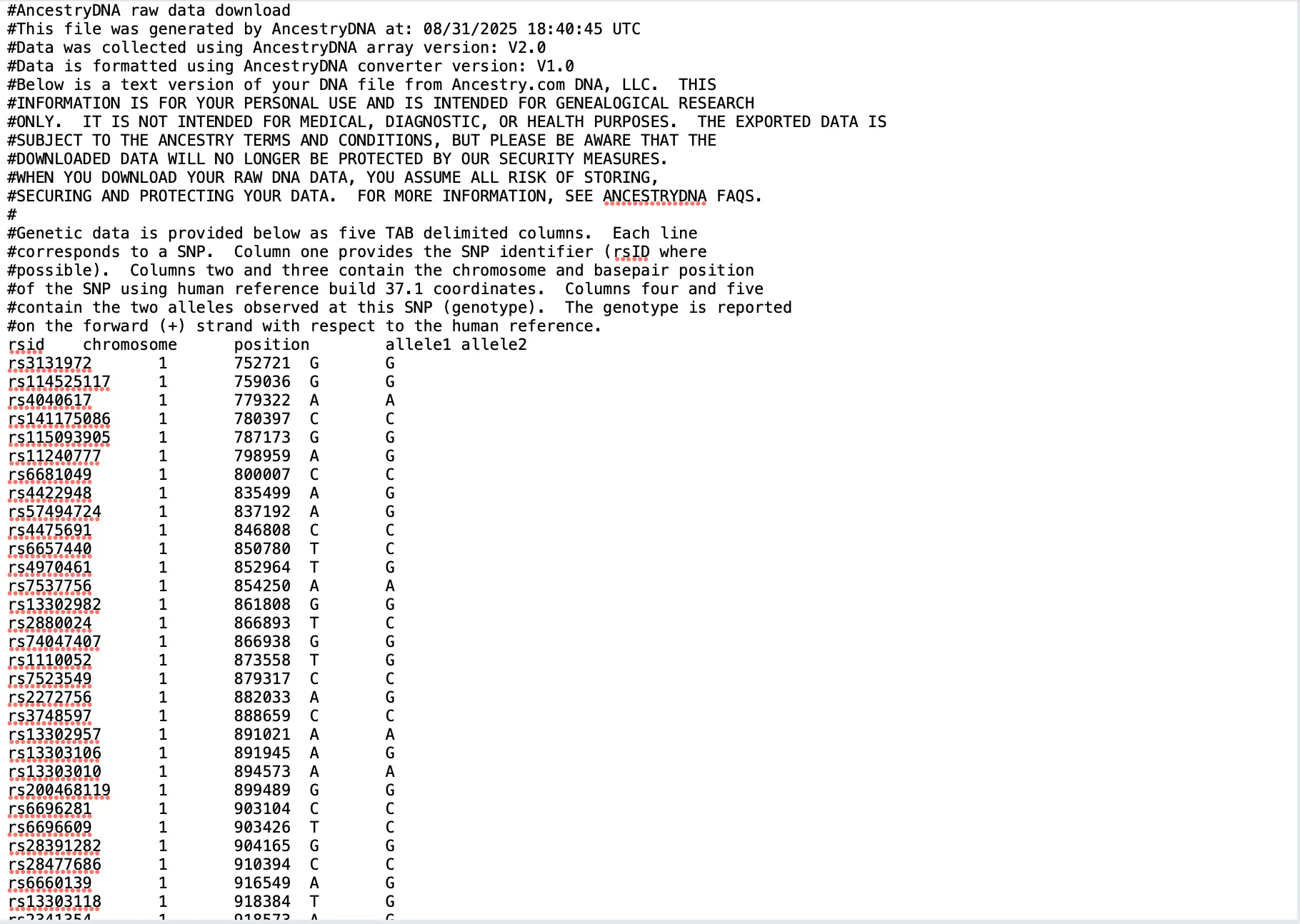
- The file records four data points per marker: a unique ID (rsID), chromosome number, position on the chromosome, and your genotype (two-letter code representing the bases you inherited from each parent).
- To interpret the file, you need either a specialized third-party analysis tool or a public scientific database. The raw letters and numbers carry no inherent meaning without a reference framework.
- Consumer DNA tests analyze around 600,000–700,000 selected SNPs, not the entire genome. Results are informational, not diagnostic.
- Your raw DNA file is highly sensitive personal data. Only upload it to verified, privacy-compliant platforms.
| QUICK ANSWER: Raw DNA data is a plain text file containing hundreds of thousands of genetic markers (SNPs). Each row shows four values: a marker ID (rsID), chromosome number, position, and your genotype (two letters like AA or CT). The file requires a specialist tool or database to interpret; it is not readable on its own. It is informational only, not a clinical diagnosis. |
What Information Does A Raw DNA File Contain?
Before exploring the types of DNA data, it helps to understand what every raw DNA file has in common.
Regardless of whether it is from 23andMe, AncestryDNA, or another platform, raw DNA data is almost always a plain text file (.txt or .csv) that can be opened in any text editor or spreadsheet application.
Each row in the file represents a single genetic variant, specifically, a type of variation called a SNP (Single Nucleotide Polymorphism, pronounced 'snip').
SNPs are the most common form of genetic variation in the human genome, occurring at millions of positions across our chromosomes.[1].
Consumer DNA tests sample a selected subset of these, typically 600,000 to 700,000 SNPs for standard kits like 23andMe (v5 chip) or AncestryDNA[2][6].
| Column | Example Value | What It Means | Why It Matters |
| rsID | rs4941876 | Universal identifier for this SNP in scientific databases | Allows you or a tool to look up this marker in research literature |
| Chromosome | 6 | Which chromosome this SNP is located on (1–22, X, Y, MT) | Organizes markers by their location in your genome |
| Position | 26,093,141 | Exact coordinate along the chromosome | Pinpoints the SNP's location to a single DNA base pair |
| Genotype | AG | The two DNA bases you carry at this location (one from each parent) | The core data point compared against databases to generate insights |
How To Read Raw DNA Data?
When you download your raw DNA file from a consumer testing service, you receive a dense text file that can be difficult to make sense of. This guide explains exactly what the file contains, how the three main types of DNA data are structured, how to analyze it, and what you should and should not do with the results.
What Are The Three Types Of Raw DNA Data?
1. Autosomal DNA
Autosomal DNA refers to the 22 pairs of chromosomes that are not involved in determining biological sex.
These are inherited in equal parts from both biological parents, approximately 50% from the mother and 50% from the father.
Because this DNA is a mix of both parental lines, it provides the most comprehensive view of your genetic heritage[4].
It is the primary tool used by researchers and genealogists to identify relatives across your entire family tree, spanning both maternal and paternal sides.
The autosomal section of your raw data file follows the four-column format described above (rsID, chromosome, position, genotype) and will contain the bulk of the file's rows.
2. Mitochondrial DNA (mtDNA)
Mitochondrial DNA is genetic material found in the mitochondria, the energy-producing structures in your cells.
It is passed almost exclusively from the biological mother to child, meaning it traces your direct maternal line (your biological mother, her mother, her mother's mother, and so on) back thousands of years.
Because mtDNA is not recombined between generations the way autosomal DNA is, it remains nearly identical across many generations, accumulating only rare mutations.
These mutations are the markers that define maternal haplogroups, the major branches of the human family tree that trace ancient migration routes[4].
In a raw mtDNA file, you will find:
- a list of positive markers only (markers you carry, not all tested positions)
- haplogroup-defining markers used to assign you to a maternal branch
- alternative names for each marker (since the same variant can have multiple designations in different research systems).
Note: In extremely rare documented cases, paternal mtDNA transmission has been observed though this is not a factor in standard genealogical testing. Both biological males and females carry mtDNA; only biological females pass it on[5].
3. Y-Chromosome DNA (Y-DNA)
Y-DNA is genetic material on the Y chromosome, which ispassed from biological father to biological son with very few changes between generations.
Because biological females carry two X chromosomes rather than a Y, Y-DNA testing is relevant only for biological males tracing their direct paternal line.
The rare mutations that do accumulate on the Y chromosome over thousands of years define paternal haplogroups, making Y-DNA a precise tool for tracing deep ancestral origins along a single lineage.
A Y-DNA raw data file, like the mtDNA file, contains only positive markers, haplogroup-defining variants, and reliability checks that ensure you are assigned to the correct branch of the paternal tree.
It is worth noting that most consumer DNA testing platforms focus on SNP-based Y-DNA testing (which defines major ancestral branches) rather than STR-based testing (Short Tandem Repeats, which is more commonly used for close genealogical matching within a few generations). These are complementary approaches used for different genealogical purposes.
| Expert picks: What To Read Next |
|---|
| Autosomal DNA Testing: Everything You Need To Know |
| How Nutrigenomics is Changing the Way We Think About Food |
How To Open and Navigate Your Raw DNA File
Your raw DNA file is typically delivered as a compressed .zip archive from your testing provider's account settings.
Depending on your provider, the exact steps to download your raw DNA file will vary.
Here’s a general overview of how to access your raw DNA file.
- Log into your account on the testing provider's website (e.g., 23andMe, AncestryDNA) and navigate to Settings or Account.
- Find the 'Download Raw Data' option. You will usually need to re-authenticate with your password for security.
- Download and unzip the file. On most operating systems, right-click the .zip file and select 'Extract All.'
- Open the .txt or .csv file in a text editor (Notepad, TextEdit) or import it into a spreadsheet (Excel, Google Sheets).
- The first several lines will contain # comment rows describing the platform and download date. The data begins after these.
- To find a specific marker, use Ctrl+F (Find) or Command+F and search for the rsID (e.g., rs334 for the sickle cell trait marker).
How To Analyze Raw DNA Data
Once you have your raw DNA file, you essentially hold a massive book written in a genetic code.
While you can open the file and see the individual letters, they don’t provide much meaning on their own.
To make sense of the data, you need to use tools that "translate" these markers into information about your health, traits, and ancestry.
Option 1: Third-party Apps (Recommended for Most People)
Uploading your data to a third-party analysis service is the most straightforward way to get detailed results.
These companies compare your raw markers against their own extensive research databases to generate user-friendly reports.
- What They Provide: These services can identify over 250 genetic traits, ranging from food sensitivities and vitamin deficiencies to physical characteristics and personality tendencies.
- Health and Ancestry: Some platforms offer deep dives into global ancestry and potential health risks, while others are excellent for finding "Shared DNA Matches" to connect you with long-lost relatives.
- Wellness Information: Some platforms like Xcode Life go beyond basic health risks and cover wider health and wellness categories like nutrition, methylation, sleep health, fitness, skin health, behavior and personality, PGx responses, etc.
- Convenience: This is generally considered the best option for most people. The company does the heavy lifting of interpreting the numbers and letters, providing you with a finished report that explains what the findings mean for your life and heritage.
What to look for in a reputable analysis platform: HIPAA/GDPR compliance; clear data deletion policies; transparent sourcing of scientific references; no sale of your data to third parties. Examples of established platforms include Promethease (health-focused, uses SNPedia), GEDmatch (ancestry and DNA matching), and specialist services for nutrition and trait analysis. Always read the privacy policy before uploading.
Health And Wellness Analysis Starting At $30
Discover the power of your DNA and get the most out of your ancestry test raw data with Xcode Life! Say goodbye to one-size-fits-all health advice and hello to tailored wellness insights. No new DNA test required! Simply upload your data from services like 23andMe or AncestryDNA, and receive user-friendly, actionable insights within hours. We prioritize your privacy, offering secure and supportive platforms to understand your unique genetic makeup.
| Expert pick: What To Read Next |
|---|
| 2026 Update: Free Tools For 23andMe, AncestryDNA, FTDNA Raw Data Analysis |
Option 2: Manual Lookup via Public Databases
If you are interested in a specific genetic marker, you can look it up directly in public scientific databases without uploading your full file anywhere. This approach is more technical but gives you direct access to the underlying research. This is a more manual, "do-it-yourself" method used by researchers and enthusiasts.
- Searching by rsID: You can take a specific rsID from your raw data (e.g., rs4941876) and search for it in databases like dbSNP or Ensembl. These sites will tell you what that specific marker is associated with in scientific literature.
- Advanced Quality Control: For those working with more complex sequencing data, tools like FastQC are used to check the quality of the data.
- Mapping and Alignment: Advanced users may use tools like BWA (Burrows-Wheeler Aligner) to map their DNA reads against a reference human genome. Following this, software like SAMtools or VarScan can be used to identify specific insertions or deletions in the code.
Some free online databases include
- dbSNP: Best for basic SNP lookup
- Ensemble Genome Browser: Best for detailed annotation
- Clinvar: Best for clinical significance
- GWAS catalog: Best for trait associations
- SNPedia: Best for easy-to-read explanations
If you use any analysis tool, automated or manual, and discover information suggesting a significant health risk, consult a certified genetic counselor or your healthcare provider before acting on the findings. A genetic counselor can help you understand the clinical significance of the result and whether clinical confirmatory testing is appropriate.
How To Read Raw DNA Data: Dos and Don'ts
Raw DNA data files can look confusing because they contain thousands of lines of genetic markers.
Each line represents a single genetic variant (SNP) and usually includes the rsID, chromosome number, position on the chromosome, and your genotype (two letters such as AA, CT, or GG).
Here are some basic dos and don’ts to keep in mind when reviewing this data.
Dos
1. Understand what each column means
A typical raw DNA file lists the SNP identifier (rsID), the chromosome where it is found, its position, and your genotype. The genotype is written using the four DNA bases: A, C, G, and T, which represent nucleotides in your DNA.
2. Use trusted databases or tools for interpretation
The letters and numbers in a raw DNA file do not explain health traits or ancestry on their own. Many people upload the file to specialized analysis tools or genetic databases that compare the variants with scientific research to generate understandable reports.
3. Look up specific SNPs carefully
If you want to investigate a particular genetic marker, you can search for its rsID in research databases or SNP databases. The rsID acts as a universal identifier used by scientists to study genetic variants.
Don’ts
1. Don’t assume raw data equals a diagnosis
Raw DNA files are mainly designed for research or informational purposes. They are not clinical tests, so the results should not be used to diagnose medical conditions.
2. Don’t interpret single variants in isolation
Most traits and health risks are influenced by multiple genes and environmental factors, so looking at just one genetic marker rarely provides a complete picture.
3. Don’t panic over unfamiliar results
It’s common to see missing data or unusual-looking entries in raw files. For example, some markers may appear blank if the test could not detect them clearly.
4. Don’t share your raw DNA data casually
A raw DNA file contains sensitive genetic information. If you upload it to third-party tools, make sure they are trustworthy and follow good privacy practices.
Key Considerations
- Raw DNA files contain sensitive genetic information, so it is important to choose trusted and secure platforms when uploading your data for analysis.
- Most consumer DNA tests analyze selected genetic markers (SNPs) rather than the entire genome, so the insights may be limited.
- Different analysis tools may interpret the same genetic variants differently, depending on the databases and research they use.
- Health insights from raw DNA analysis are informational, not diagnostic, and any important findings should be discussed with a qualified healthcare professional.
- It is also helpful to understand that genetics is only one part of the picture.
- Lifestyle, environment, and other factors also influence most traits and health outcomes.
FAQs
Your raw DNA file tells you the specific DNA bases you carry at hundreds of thousands of locations across your genome. With appropriate analysis tools, this data can reveal your estimated ethnic ancestry breakdown, connect you with biological relatives who share DNA segments with you, and flag genetic variants that scientific research has associated with traits, nutrient processing, or health predispositions. It cannot diagnose medical conditions.
While newer ChatGPT models can technically read text in a raw DNA file and explain specific markers, they are not suitable for comprehensive genetic analysis. Most AI models are limited by the size of their training data and cannot process hundreds of thousands of rows at once, increasing the risk of "hallucinations" or scientifically inaccurate interpretations. Further, uploading your genetic code to a general AI platform raises serious privacy concerns, as the data may be used for model training and lacks the strict medical-grade security found in specialized laboratories.
There are two approaches. The automated approach: upload your file to a specialist third-party platform that compares your markers against research databases and generates readable reports. The manual approach: look up individual rsIDs in public databases like NCBI dbSNP or SNPedia to find the research associated with that specific marker. For health-related findings, always discuss results with a certified genetic counselor.
23andMe and similar platforms report genotyping call accuracy above 99% for the specific markers they test. You can request this raw DNA file and download them to your system. For reading and analyzing data, you can uplaod it to secure third-party tools like Xcode Life.
No, 23andMe does not allow upload of third-party raw DNA files.
Some platforms offer free basic analysis of raw DNA files. Promethease (now part of MyHeritage) offers low-cost health-focused SNP analysis. SNPedia is free to browse manually by rsID. However, free tools vary significantly in depth and scientific rigour. Any health-related findings from these tools should be confirmed with a clinical genetic test and reviewed by a healthcare professional.
References
[1] NCBI dbSNP Overview — ncbi.nlm.nih.gov/snp PMID 34285776
[2] SNP Genotyping Technologies and Genome-Wide Association Studies PMID 30478036
[3] Genomic Data Privacy and Security Considerations PMID 37965371
[4] Genome Sequencing Overview — NCBI Bookshelf NBK557512
[5] Luo S et al. (2018). Biparental Inheritance of Mitochondrial DNA in Humans. PNAS. doi:10.1073/pnas.1810946115
[6] 23andMe v5 Genotyping Chip — Platform Documentation 23andMe.com